
Inconsistent Preform Weight? Meto Solves the Problem with 0.3% Cavity-to-Cavity Tolerance
Inconsistent Preform Weight? Meto Solves the Problem with 0.3% Cavity-to-Cavity Tolerance
Preform weight variation is one of the most common — and costly — problems in PET bottle production. When cavities produce preforms of different weights, the consequences ripple through every downstream process.
Light preforms become thin bottles that leak or burst. Heavy preforms waste material and create thick, heavy bottles that cost more to transport. And somewhere in between, every bottle is different from the next.
Many preform mold manufacturers promise consistency. Few deliver it. Meto guarantees cavity-to-cavity weight variation of 0.3% or less — not as a marketing claim, but as a verified, documented result from every mold we ship.
This article explains why preform weight variation occurs, why it matters, and how Meto‘s engineering approach achieves industry-leading consistency.
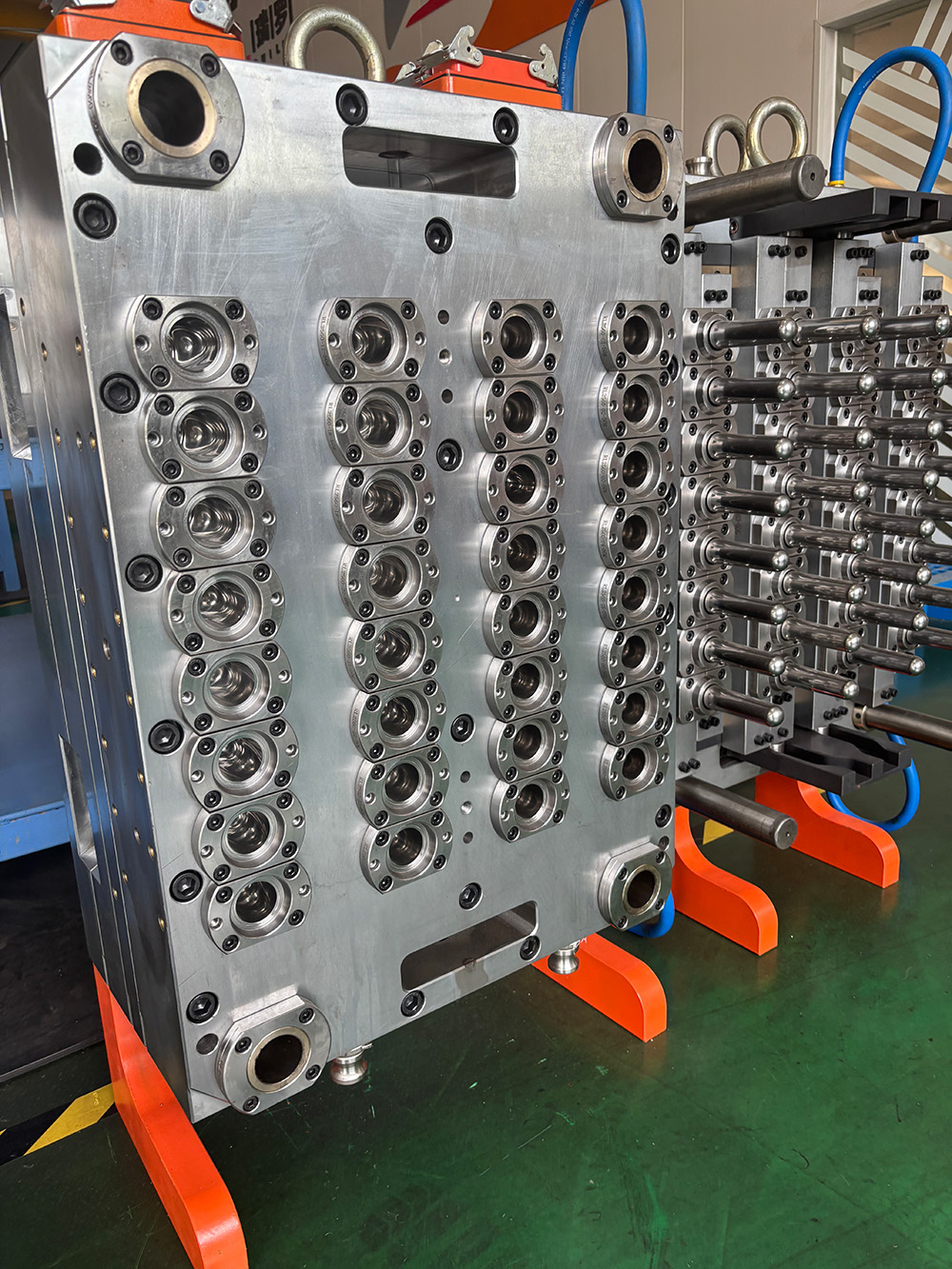
Part 1: What Is Preform Weight Variation?
Preform weight variation is the difference in weight between the heaviest and lightest preform produced in a single cycle from a multi-cavity mold.
Example: A 16-cavity mold produces 16 preforms per cycle.
| Cavity | Preform Weight (g) |
|---|---|
| Cavity #1 | 18.05 |
| Cavity #2 | 18.02 |
| Cavity #3 | 18.08 |
| ... | ... |
| Cavity #16 | 17.98 |
In this example, the range is 18.08g – 17.98g = 0.10g variation. As a percentage of the average weight (18.03g), this is 0.55% variation.
Meto‘s guarantee: 0.3% or less. For the same 18g preform, this means maximum variation of 0.054g.
Part 2: Why Preform Weight Variation Matters
2.1 Material Waste — The Most Direct Cost
When preform weights vary, the production line must be set up for the heaviest preform in the cycle. Why? Because if the line is set for the average weight, the lightest preforms will produce bottles that are too thin.
The math of material waste:
| Scenario | Average Preform Weight | Variation | Effective Material Use |
|---|---|---|---|
| Poor consistency | 18.0g | 1.0% (0.18g) | Must run at 18.09g average to protect lightest cavity |
| Meto consistency | 18.0g | 0.3% (0.054g) | Can run at 18.03g average |
Annual material savings (50 million preforms):
Poor consistency: 50M × 18.09g = 904.5 tons PET
Meto consistency: 50M × 18.03g = 901.5 tons PET
Savings: 3 tons of PET per year
At 3,000 per year per 50 million preforms. For larger volumes, savings scale proportionally.
2.2 Bottle Quality Problems
| Problem | Cause |
|---|---|
| Leaking bottles | Light preforms blow into thin bottle walls |
| Bursting under pressure | Carbonated bottles fail at thin spots |
| Inconsistent filling volume | Bottle volume varies with preform weight |
| Labeling issues | Bottle dimensions vary from cavity to cavity |
| Customer complaints | Inconsistent bottle feel and performance |
2.3 Blow Molding Inefficiency
Blow molds are optimized for a specific preform weight and wall thickness distribution. When preform weight varies, the blow molding process cannot compensate. The result:
Higher reject rates at the blow molding stage
Longer cycle times (wider safety margins required)
Increased energy consumption per bottle
2.4 Downstream Ripple Effects
Weight variation in preforms creates problems that multiply through the production line:
Preform → Blow → Fill → Cap → Label → Pack → Ship
A problem at the preform stage affects every subsequent step. By the time a thin bottle leaks during shipping, it is too late to trace the problem back to a single preform cavity.
Part 3: What Causes Preform Weight Variation?
Preform weight variation has four main causes. Meto addresses all four.
3.1 Hot Runner Imbalance (Most Common)
The hot runner system delivers molten PET to each cavity. If flow is not perfectly balanced, some cavities receive more material than others.
Common causes of hot runner imbalance:
Uneven flow path lengths
Inconsistent nozzle temperatures
Poor manifold design
Valve gate timing issues
Meto‘s solution: Computer flow simulation of every hot runner design. Individual valve gate timing adjustment. Precision temperature control on every nozzle (±1°C).
3.2 Cavity Dimension Variation
If cavities are machined to different dimensions, they will produce preforms of different weights — even with perfectly balanced melt flow.
Common causes:
Tool wear during CNC machining
Inconsistent machining between shifts
Lack of in-process inspection
Meto‘s solution: All cavities machined on the same CNC setup. CMM inspection after rough and finish passes. Cavity-to-cavity dimensional variation held to ±0.01mm.
3.3 Cooling Non-Uniformity
Cooling affects crystallinity and final density. Even if the same mass of PET enters each cavity, uneven cooling can produce different preform weights due to density variation.
Common causes:
Straight-drilled cooling channels with varying distance from cavity
Blocked or scaled cooling lines
Poor coolant flow distribution
Meto‘s solution: Conformal cooling design. Individual cavity cooling circuits with flow meters. Thermal imaging verification (temperature variation ≤3°C).
3.4 Venting Differences
If some cavities vent better than others, trapped air can affect filling and packing — leading to weight variation.
Common causes:
Inconsistent vent depth
Blocked vents
Poor vent placement
Meto‘s solution: Standardized vent dimensions across all cavities. Vent cleaning during mold maintenance. CFD analysis of vent placement.
Part 4: How Meto Achieves 0.3% Weight Consistency
Achieving 0.3% cavity-to-cavity weight variation requires discipline across design, manufacturing, and testing.
4.1 Design Phase — Simulation Before Steel
Meto does not guess. Every 48-cavity — even every 8-cavity mold — undergoes computer simulation before manufacturing begins.
Hot runner flow simulation:
Models melt flow from main inlet to each nozzle
Identifies flow imbalances before machining
Adjusts runner diameters and lengths to balance flow
Predicts cavity-to-cavity fill variation
Cooling simulation (CFD):
Models coolant flow through every channel
Identifies hot spots and cold spots
Optimizes channel placement for uniform cooling
Result: By the time steel is cut, Meto already knows the mold will achieve 0.3% weight variation.
4.2 Manufacturing Phase — Precision at Every Step
| Step | Meto Standard | Typical Industry Standard |
|---|---|---|
| CNC machining tolerance | ±0.01mm | ±0.02–0.03mm |
| Cavity surface finish | Ra 0.2–0.4μm | Ra 0.4–0.8μm |
| Hardness variation (cavity to cavity) | ±1 HRC | ±2–3 HRC |
| Cooling channel placement | ±0.2mm | ±0.5–1.0mm |
All cavities are machined in the same setup to eliminate variation between shifts or machines.
4.3 Testing Phase — Verification, Not Assumption
Every Meto preform mold undergoes trial molding before shipment. The test protocol includes:
Warm-up cycle – 50 shots to reach thermal equilibrium
Sample collection – 10 consecutive shots from steady-state production
Weight measurement – Every preform from every cavity weighed
Statistical calculation – Variation percentage calculated
Documentation – Cavity-by-cavity weight report provided to customer
Acceptance criteria: Weight variation ≤0.3% before mold leaves Meto‘s facility.
If a mold exceeds 0.3% variation, it does not ship. Meto diagnoses the cause (hot runner adjustment, cavity rework, cooling adjustment) and fixes it before delivery.
Part 5: Real Customer Results
Customer A: 32-Cavity Water Preform Mold (Thailand)
| Metric | Before (Previous Supplier) | Meto Mold |
|---|---|---|
| Cavity-to-cavity weight variation | 0.85% | 0.28% |
| Preform weight (average) | 18.2g | 18.0g (reduced due to consistency) |
| Annual material savings | — | $28,000 |
| Reject rate (preform stage) | 1.2% | 0.4% |
Customer comment: “We were able to lower our target preform weight by 0.2g because we no longer needed to protect the lightest cavity. That is real money every day.”
Customer B: 48-Cavity CSD Preform Mold (Brazil)
| Metric | Before (Different Supplier) | Meto Mold |
|---|---|---|
| Cavity-to-cavity weight variation | 0.62% | 0.31% |
| Blow molding reject rate | 2.1% | 1.1% |
| Line speed | 45,000 bottles/hour | 48,500 bottles/hour |
Customer comment: “The blow molding operator noticed the difference immediately. Consistent preforms mean consistent bottles. Less adjustment. Less scrap.”
Customer C: 16-Cavity rPET Preform Mold (Europe)
| Metric | Previous Mold (Same Supplier, Old Design) | Meto Mold |
|---|---|---|
| Cavity-to-cavity weight variation | 0.45% | 0.22% |
| rPET content | 30% | 50% (enabled by consistency) |
Customer comment: “The consistency of Meto‘s mold allowed us to increase rPET content without increasing rejects. That is a sustainability win and a cost win.”
Part 6: Comparing Weight Variation Standards
| Supplier Type | Typical Weight Variation | Verification |
|---|---|---|
| Low-cost local supplier | 1.0–1.5% | Rarely measured |
| Average Asian supplier | 0.6–0.9% | Spot-checked |
| Premium European supplier | 0.4–0.6% | Documented |
| Meto | 0.3% or less | Every cavity, every mold, documented |
Meto‘s 0.3% guarantee places us at the leading edge of preform mold consistency — comparable to or better than premium European suppliers at a competitive price point.
Part 7: The 0.3% Guarantee — What It Means for You
When Meto quotes a preform mold, we include a written guarantee:
*“The finished preform mold will produce preforms with cavity-to-cavity weight variation of 0.3% or less of the average preform weight, as verified by weighing ten consecutive shots from all cavities under stable production conditions.”*
What this means for your production:
| Benefit | Impact |
|---|---|
| Lower material cost | Run at true average weight, not artificially high |
| Consistent bottle quality | Every bottle meets specifications |
| Higher blow molding yield | Fewer rejects from preform variation |
| Predictable production | No surprises when changing molds |
| Faster line validation | Less time adjusting for cavity variation |
Part 8: Factors That Affect Preform Weight (Beyond the Mold)
Even the best mold will produce inconsistent preforms if other factors are not controlled. Meto educates customers on these external factors:
| Factor | Impact | What to Check |
|---|---|---|
| Injection unit consistency | Shot-to-shot variation | Check screw position repeatability |
| Melt temperature variation | Density changes | Monitor barrel zone temperatures |
| Cooling water temperature | Density changes | Maintain ±1°C at mold inlet |
| Cycle time stability | Crystallization variation | Consistent cooling time |
| Regrind ratio variation | Melt flow changes | Consistent regrind percentage |
Meto‘s 0.3% guarantee assumes the customer‘s injection machine and auxiliary equipment are operating within normal parameters. For customers with machine issues, Meto offers process troubleshooting to identify root causes.
Conclusion: Consistency Is Not Optional
In high-volume PET bottle production, preform weight consistency is not a luxury. It is a requirement for competitive operation. Every 0.1% of unnecessary weight variation is material cost wasted. Every inconsistent preform creates risk downstream.
Meto‘s 0.3% cavity-to-cavity weight variation guarantee is backed by:
Hot runner flow simulation and precision balancing
CNC machining with ±0.01mm tolerance
Conformal cooling with thermal imaging verification
100% trial molding with documented results
Whether you run 2 million or 200 million preforms per year, consistent preform weight improves your bottom line.
If you are tired of adjusting for cavity variation, calculating “safety margins” on preform weight, or explaining to customers why bottles are inconsistent — talk to Meto.

Ruby
We can provide you with high-quality PET preform molds,cap molds,and blow molding machines.Looking forward to communicating and cooperating with you!
Helpline and Support
008613757660057