
Cooling Channel Design Is More Than Drilling: Analysis of Meto Conformal Cooling Technology
Cooling Channel Design Is More Than Drilling: Analysis of Meto Conformal Cooling Technology
Cooling accounts for 60 to 80 percent of the total preform molding cycle. Faster cooling means faster cycles. Uniform cooling means consistent preform quality. Poor cooling causes longer cycle times, warped preforms, crystallization in the neck, and hot spots that accelerate mold wear.
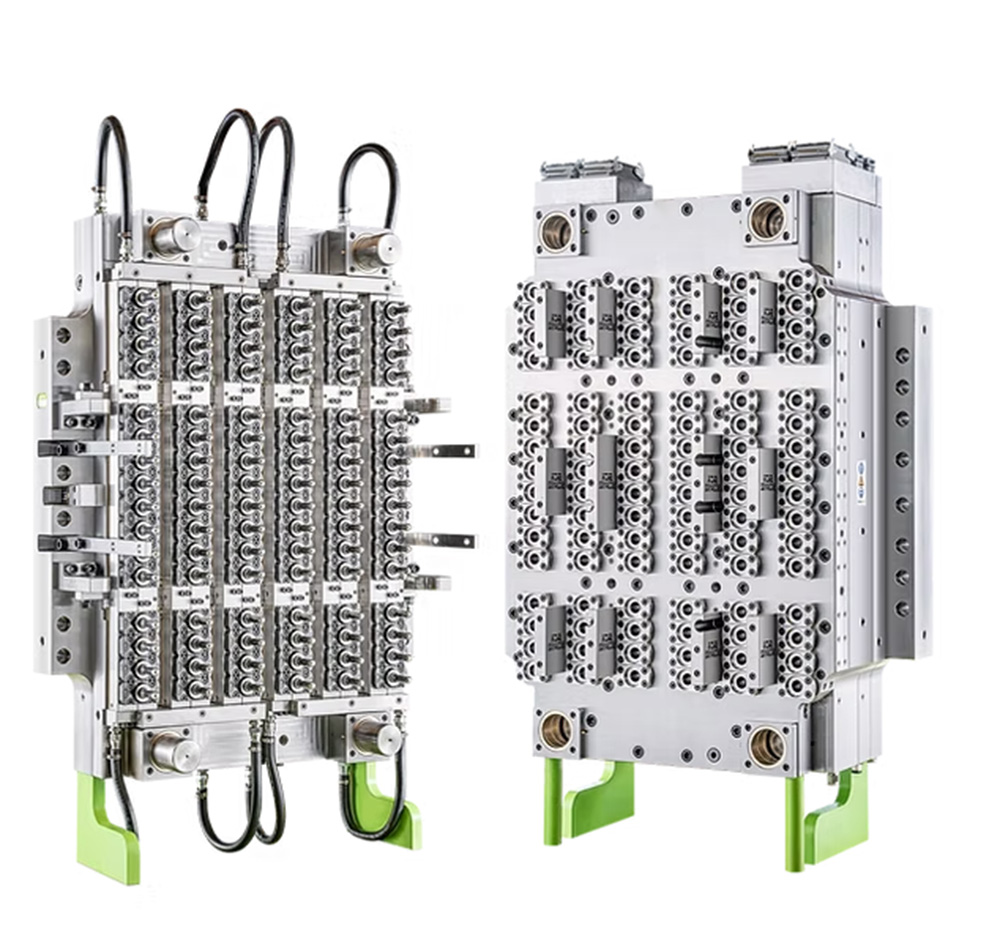
For decades, mold makers drilled straight lines through mold plates. These straight cooling channels worked reasonably well for simple shapes. But preforms and bottles are not straight. The distance from a straight cooling channel to the cavity surface varies. Some areas are close to the channel and cool quickly. Some areas are far and cool slowly. The result is uneven cooling.
Meto uses conformal cooling technology. Cooling channels follow the contour of the cavity. The distance from channel to cavity surface is constant. Cooling is uniform. Cycle times are shorter. Quality is better. This article explains what conformal cooling is, how it works, and why Meto uses it for preform molds, cap molds, and blow molds.
Part 1: What Is Conformal Cooling
Conformal cooling means cooling channels that follow the shape of the cavity. The channel is not a straight line. It curves and bends to maintain a constant distance from the cavity surface.
Imagine a preform cavity. It has a neck, a shoulder, a straight body, and a rounded bottom. A straight cooling channel drilled through the mold plate might be 10 millimeters from the cavity at the shoulder but 20 millimeters from the cavity at the body. Cooling is uneven.
A conformal cooling channel curves to stay 10 millimeters from the cavity at every point. The neck has its own channel. The shoulder has a curved channel. The body has a channel that runs parallel to the cavity wall. The bottom has a channel that follows the curve.
The result is uniform cooling temperature across the entire cavity.
Part 2: Why Conventional Cooling Falls Short
Conventional cooling uses straight drilled channels. This method is simple and low cost. But it has significant limitations.
First, distance from channel to cavity varies. Some areas are close and cool quickly. Some areas are far and cool slowly. The preform cools unevenly. Uneven cooling causes warpage and dimensional variation.
Second, straight channels cannot reach complex features. The neck finish of a preform is critical for cap sealing. Straight channels often cannot cool the neck uniformly. Crystallization occurs. Caps do not seal.
Third, straight channels create hot spots. A hot spot is an area with poor cooling. Hot spots accelerate mold wear. The cavity may crack or pit prematurely.
Fourth, straight channels limit cycle time. The mold must wait for the slowest cooling area. Cycle time is determined by the worst cooled cavity area.
Part 3: How Conformal Cooling Is Made
Conformal cooling channels cannot be made with standard drilling. The channels curve. Special manufacturing methods are required.
One method is 5 axis CNC machining. A long ball end mill enters the mold plate at an angle and cuts a curved channel. The tool moves in three dimensions to follow the cavity contour. This method works for channels with gradual curves.
Another method is direct metal laser sintering or DMLS. The mold cavity and cooling channels are built layer by layer from metal powder. A laser melts the powder in the shape of the cavity and channels. This method allows channels of any shape, including very tight curves and branches. It is more expensive than machining but allows cooling designs not possible with machining.
Meto uses 5 axis CNC machining for most conformal cooling applications. This provides good conformal cooling at reasonable cost. For very complex shapes, Meto offers DMLS.
Part 4: Conformal Cooling for Preform Molds
The preform mold has three zones that benefit from conformal cooling.
The neck finish is the most critical area. The neck must cool quickly and uniformly to prevent crystallization. Crystallization makes the neck white and brittle. Caps may not seal. Meto uses conformal cooling channels that wrap around the neck finish. The channel follows the thread profile. Cooling is uniform across all threads.
The shoulder is where the preform expands from the neck to the body. This area is prone to warpage if cooling is uneven. Meto uses curved conformal channels that follow the shoulder contour.
The body is the long straight section of the preform. Conventional cooling often uses straight channels here. The distance from channel to cavity is constant along the body, so straight channels work reasonably well. Meto adds baffles or turbulators to increase cooling efficiency.
Part 5: Conformal Cooling for Cap Molds
Cap molds have different cooling challenges.
The thread area is the most critical. The threads must cool quickly to maintain dimensional accuracy. Poor cooling causes thread shrinkage and inconsistent torque. Meto uses conformal cooling channels that follow the thread helix. This is the most complex conformal cooling application. Channels must curve in a spiral.
The sealing surface must be round and smooth. Uneven cooling causes ovality. Meto uses a circular conformal channel around the sealing surface.
The top of the cap must cool uniformly to prevent sink marks. Meto uses a conformal channel that follows the cap profile.
Part 6: Conformal Cooling for Blow Molds
Blow molds also benefit from conformal cooling.
For stretch blow molds, the bottle shape is often complex. Curves, handles, and indentations create cooling challenges. Meto uses conformal cooling channels that follow the bottle contour. This is especially important for hot fill bottles where cooling time is critical.
For extrusion blow molds, the pinch off area experiences high heat. The pinch off must cool quickly to prevent sticking. Meto uses conformal cooling channels that follow the pinch off contour.
Part 7: Benefits of Conformal Cooling
Faster cycle time is the most obvious benefit. Cooling is the longest part of the molding cycle. Conformal cooling reduces cooling time by 15 to 30 percent. For a preform mold running a 10 second cycle, a 2 second reduction increases output by 20 percent.
Uniform cooling means consistent shrinkage. Consistent shrinkage means consistent dimensions. Preform weight variation decreases. Bottle wall thickness becomes more uniform.
Better part quality includes reduced warpage, elimination of hot spots, less crystallization in preform necks, and improved cap sealing.
Longer mold life results from uniform temperatures. Hot spots accelerate wear. Conformal cooling eliminates hot spots. The mold lasts longer.
Lower energy cost comes from faster cycles. The machine runs fewer hours to produce the same number of parts.
Part 8: Real Customer Results
A water bottler in Southeast Asia used a 32 cavity preform mold with conventional cooling. Cycle time was 10.5 seconds. Neck crystallization was visible on some cavities. The customer switched to a Meto mold with conformal cooling. Cycle time dropped to 8.2 seconds, a 22 percent reduction. Neck crystallization disappeared. Output increased by 28 percent on the same machine.
A cap manufacturer in South America produced 28mm CSD caps. Cycle time with conventional cooling was 6.2 seconds. Torque variation was plus or minus 0.15 Newton meters. The customer switched to a Meto mold with conformal cooling in the thread area. Cycle time dropped to 5.4 seconds. Torque variation improved to plus or minus 0.09 Newton meters.
A blow mold customer in Europe made 1.5 liter PET bottles. Hot fill application required long cooling time to prevent bottle shrinkage. Conventional cooling achieved 18 second cycle. Meto conformal cooling reduced cycle time to 14 seconds. The customer increased daily output by 28 percent.
Part 9: Cost Benefit Analysis
Conformal cooling adds cost to the mold. The additional machining is more expensive than straight drilling. DMLS is even more expensive.
But the additional cost pays back quickly through faster cycles.
Consider a 32 cavity preform mold running 5 million cycles per year. Conventional cooling cycle time is 10 seconds. Conformal cooling cycle time is 8 seconds. The difference is 2 seconds per cycle.
At 5 million cycles per year, the time savings is 10 million seconds or 2,778 hours per year. At 100 dollars per hour machine cost, the annual savings is 277,800 US dollars.
The additional cost for conformal cooling on a preform mold is typically 5,000 to 15,000 US dollars. Payback period is less than one month.
Even at lower production volumes, payback is fast. At 1 million cycles per year, annual savings is 55,600 US dollars. Payback is still only a few months.
Part 10: When Conformal Cooling Is Essential
Conformal cooling is not always necessary. For low volume production, straight cooling may be sufficient. For simple shapes with uniform wall thickness, conventional cooling works well.
Conformal cooling is essential in several situations.
High volume production where every second of cycle time matters. Complex shapes with varying wall thickness. Preform neck finishes where crystallization is a concern. Hot fill bottles where cooling time is critical. Cosmetics and medical parts where dimensional precision is very tight.
If any of these apply to your application, conformal cooling is worth the investment.
Part 11: Meto Conformal Cooling Design Process
Meto follows a structured process for conformal cooling design.
Step one is cavity analysis. Engineers review the cavity shape and identify areas that need enhanced cooling. The neck finish is always a priority. Shoulders and complex curves are next.
Step two is cooling simulation. Meto uses CFD or computational fluid dynamics software to simulate cooling. The simulation shows temperature distribution across the cavity. Engineers identify hot spots.
Step three is channel design. Engineers design conformal channels to eliminate hot spots and achieve uniform cooling. Channel diameter, distance from cavity, and coolant flow rate are calculated.
Step four is simulation of the new design. The simulation runs again with conformal channels. Temperature distribution is compared to the baseline. Engineers refine the channel design until temperature variation is below 3 degrees Celsius.
Step five is manufacturing. The channel design is programmed into CNC equipment or prepared for DMLS. The mold is manufactured with conformal cooling.
Step six is verification. After the mold is built, Meto uses thermal imaging to verify cooling uniformity. Actual temperature distribution is compared to simulation results.
Part 12: Thermal Imaging Verification
Meto does not guess whether conformal cooling works. We prove it.
After the mold is built and installed on a machine, Meto uses a thermal imaging camera to measure mold surface temperature. The camera shows the temperature of each cavity. A uniform color across all cavities means uniform cooling.
Meto guarantees cavity to cavity temperature variation of 3 degrees Celsius or less for molds with conformal cooling. The thermal image is included in the mold documentation.
If a customer later experiences cooling problems, Meto can perform thermal imaging remotely. The customer sends photos of the mold surface during production. Meto engineers analyze the images and recommend solutions.
Part 13: Maintenance of Conformal Cooling Channels
Conformal cooling channels are more difficult to clean than straight channels. The curves make it harder to push a brush through.
Meto designs conformal channels with cleanout ports at the ends of each channel. These ports allow access for cleaning tools and flushing fluids. For channels that cannot have cleanout ports, Meto uses larger diameters that are less likely to clog.
Meto recommends regular flushing of conformal cooling channels. A cleaning solution is pumped through the channels to remove scale and debris. Frequency depends on water quality. Monthly cleaning is typical for hard water areas.
Part 14: Limitations of Conformal Cooling
Conformal cooling has limitations.
Cost is higher than conventional cooling. The additional machining or DMLS adds to mold price.
Manufacturing time is longer. 5 axis machining of curved channels takes more time than drilling straight channels.
Cleaning is more difficult. Curved channels cannot be cleaned with a simple brush.
Not all shapes benefit equally. Very thin walls may not have enough space for conformal channels.
Despite these limitations, the benefits of faster cycles and better quality usually justify the additional cost for high volume production.
Part 15: Comparison with Other Cooling Methods
Conventional straight drilling has low cost and simple cleaning. But it provides uneven cooling and longer cycle times.
Baffled cooling uses straight channels with internal baffles to direct water flow. This improves cooling but still has uneven distance from channel to cavity. Cost is moderate.
Conformal cooling provides uniform cooling and fastest cycle times. Cost is highest. Cleaning is most difficult.
For high volume production, the cycle time savings of conformal cooling outweigh the higher cost and maintenance effort.
Part 16: Meto Cooling Guarantee
Meto guarantees uniform cooling for all molds with conformal cooling. Temperature variation across cavities is 3 degrees Celsius or less. This is verified by thermal imaging.
Meto also guarantees cycle time improvement. For a customer switching from a conventional cooling mold to a Meto conformal cooling mold, Meto guarantees a minimum cycle time reduction of 15 percent for preform molds and cap molds. For blow molds, the reduction varies by bottle shape but is typically 10 to 20 percent.
If the guaranteed cycle time reduction is not achieved, Meto will modify the cooling design at no cost.
Part 17: Conclusion
Cooling channel design is more than drilling straight lines. For high volume preform, cap, and blow molds, conformal cooling is the difference between average performance and excellent performance.
Faster cycles. Uniform cooling. Better part quality. Longer mold life. These benefits come from cooling channels that follow the cavity contour, not straight lines through the plate.
Meto has mastered conformal cooling for all three mold types. We use 5 axis CNC machining and cooling simulation to design channels that maintain constant distance from the cavity. We verify performance with thermal imaging. We guarantee results.
If you are still drilling straight cooling channels, you are leaving cycle time and quality on the table.
Contact Meto today to discuss conformal cooling for your preform, cap, or blow mold. Send your part drawing. We will provide a cooling simulation and cycle time estimate. See the difference that conformal cooling makes.

Ruby
We can provide you with high-quality PET preform molds,cap molds,and blow molding machines.Looking forward to communicating and cooperating with you!
Helpline and Support
008613757660057