
How to Choose a Preform Mold Manufacturer? Meto Provides 5 Evaluation Standards
How to Choose a Preform Mold Manufacturer? Meto Provides 5 Evaluation Standards
A preform mold is a long-term investment. Choose the right manufacturer, and you get millions of reliable cycles, consistent preform quality, and responsive support. Choose the wrong one, and you face early wear, high reject rates, slow delivery, and finger-pointing when problems arise.
But how do you evaluate a preform mold manufacturer before you buy? Price alone is a dangerous guide. The cheapest mold often costs the most over its lifetime.
This article provides five practical evaluation standards. Use them to assess any preform mold supplier — including Meto.
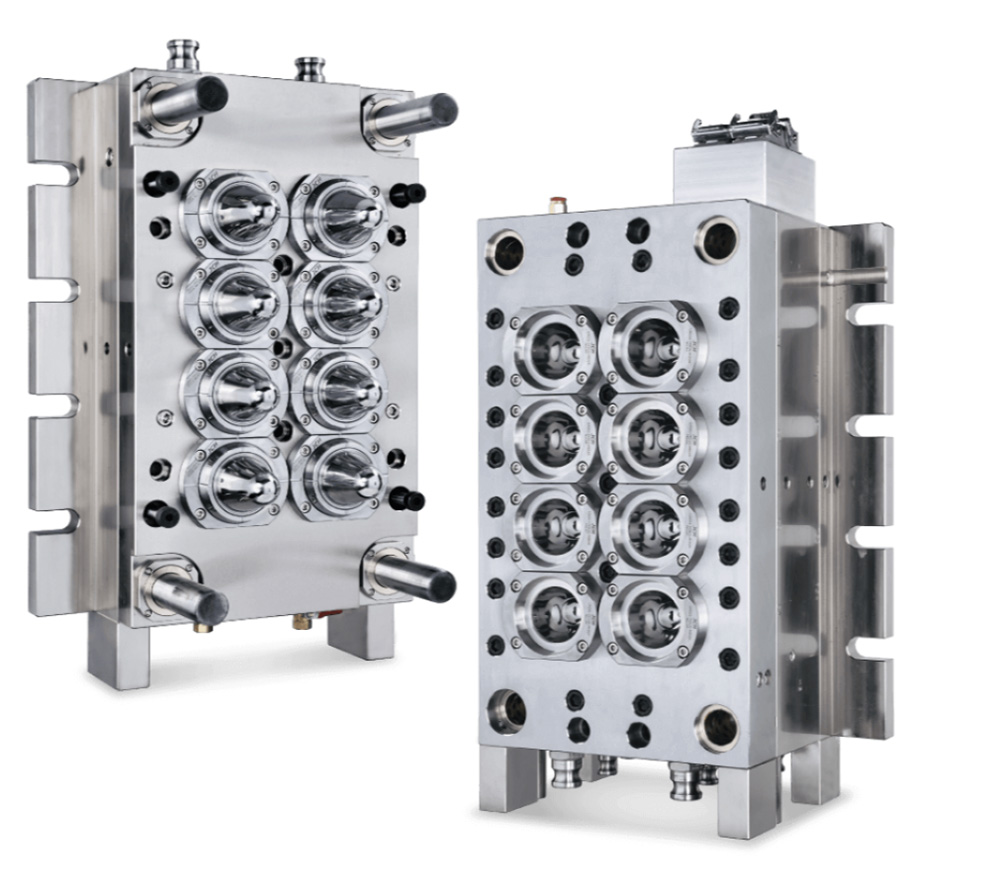
Standard 1: Steel Quality and Heat Treatment Capability
Why It Matters
The steel in your preform mold determines how long it will last before wearing out. Cheap steel wears quickly. Poor heat treatment causes cracking or soft spots. Together, steel and heat treatment are the #1 factor in mold durability.
What to Look For
| Requirement | What a Good Manufacturer Provides |
|---|---|
| Steel grade specification | Clear statement of DIN or AISI grade (e.g., 1.2343 / H11) |
| Steel certification | Mill certificates showing chemical composition |
| Heat treatment method | Vacuum heat treatment (not atmosphere furnace) |
| Tempering | Double temper (two cycles, not one) |
| Hardness documentation | Hardness test results for every cavity |
| Surface treatment options | Nitriding, PVD coating for extended life |
Questions to Ask
What steel grades do you use for high-volume preform molds?
Do you perform heat treatment in-house or outsource?
What type of furnace do you use?
How do you verify hardness on every cavity?
Can you provide hardness test reports?
Red Flags
Cannot specify steel grade beyond “tool steel”
Uses only P20 for all applications
No heat treatment documentation
Cannot provide mill certificates
Meto‘s Standard
Meto uses certified 1.2343 (H11) steel for standard high-volume preform molds. All heat treatment is performed in our own vacuum furnaces with double tempering. Every cavity is hardness-tested (48–52 HRC) and documented. Plasma nitriding is available for extended life (6–8 million cycles).
Standard 2: Cooling System Design
Why It Matters
Cooling accounts for 60–80% of the preform cycle time. Poor cooling design means longer cycles (less output) and uneven cooling (preform quality problems). Cooling also affects mold life — hot spots accelerate wear.
What to Look For
| Requirement | What a Good Manufacturer Provides |
|---|---|
| Cooling analysis | CFD (Computational Fluid Dynamics) simulation before manufacturing |
| Channel design | Conformal cooling that follows preform contour |
| Circuit separation | Independent circuits for neck, body, and bottom |
| Flow verification | Turbulent flow (Reynolds number >10,000) |
| Thermal validation | Thermal imaging report from trial molding |
Questions to Ask
Do you use cooling simulation before building molds?
What is your typical cavity-to-cavity temperature variation?
Can you provide a thermal imaging report?
Do you use conformal cooling or straight-drilled channels?
What is your guaranteed cycle time for my preform weight?
Red Flags
No cooling simulation capability
Straight-drilled channels only
Cannot provide temperature variation data
No cycle time guarantee
Meto‘s Standard
Meto uses CFD analysis to design cooling for every preform mold. We guarantee cavity-to-cavity temperature variation ≤3°C (verified by thermal imaging). Conformal cooling is standard in neck and shoulder zones. Cycle time is guaranteed in writing.
Standard 3: Cavitation and Cavity-to-Cavity Consistency
Why It Matters
Multi-cavity molds must produce identical preforms from every cavity. Weight variation causes material waste (running heavier than necessary) and bottle quality problems (light preforms blow into thin bottles).
What to Look For
| Requirement | What a Good Manufacturer Provides |
|---|---|
| Cavitation range | 2 to 48+ cavities |
| Weight variation guarantee | ≤0.5% (0.3% for premium) |
| Hot runner balance | Flow simulation + individual valve gate timing |
| Dimensional control | CMM inspection on every cavity |
| Trial molding report | Cavity-by-cavity weight data |
Questions to Ask
What is your guaranteed cavity-to-cavity weight variation?
Do you provide a trial molding report with weight data?
How do you balance your hot runner system?
What is your CMM inspection process?
Red Flags
Cannot guarantee weight variation
No trial molding report provided
Weight variation >0.8%
No CMM on site
Meto‘s Standard
Meto guarantees cavity-to-cavity weight variation ≤0.3% for all preform molds. Every mold undergoes trial molding before shipment. A cavity-by-cavity weight report is provided to the customer. Hot runner flow simulation and individual valve gate timing ensure balance.
Standard 4: Neck Finish Precision
Why It Matters
The preform neck finish interfaces with two critical components: the cap (must seal properly) and the blow mold neck ring (must hold the preform during blowing). Neck finish errors cause cap leakage, difficult opening, and blow mold alignment problems.
What to Look For
| Requirement | What a Good Manufacturer Provides |
|---|---|
| Neck finish gauges | Complete set for PCO, 38mm, and custom standards |
| Thread measurement | Optical or contact thread profile measurement |
| Cap compatibility testing | Test with actual customer caps |
| Tolerance capability | ±0.02mm or better on critical dimensions |
Questions to Ask
Do you have neck finish gauges for major standards (PCO 1881, PCO 1810, 38mm)?
How do you measure thread profiles?
Can you test preforms with my caps before shipping the mold?
What is your typical neck finish tolerance?
Red Flags
No neck finish gauges
Uses go/no-go only (no thread profile measurement)
Cannot test with customer caps
No experience with your specific neck finish standard
Meto‘s Standard
Meto maintains complete neck finish gauge sets for all major standards. Every preform mold undergoes neck finish gauge testing on every cavity. Thread profiles are measured optically. For customers ordering both preform and cap molds from Meto, we provide a neck finish compatibility certificate.
Standard 5: After-Sales Support and Spare Parts
Why It Matters
A preform mold will need maintenance, occasional repairs, and spare parts over its lifetime. A manufacturer that disappears after delivery leaves you stranded. Support quality varies enormously between suppliers.
What to Look For
| Requirement | What a Good Manufacturer Provides |
|---|---|
| Technical support | 24-hour response to inquiries |
| Spare parts | 48-hour shipping for standard wear parts |
| Documentation | Maintenance guide, part numbers, torque specs |
| Remote support | Video call, photo-based troubleshooting |
| Refurbishment services | Cavity repolishing, neck finish recutting |
Questions to Ask
What is your typical response time for technical questions?
Do you stock spare parts for molds you sold 5 years ago?
Can you provide a sample maintenance guide?
Do you offer on-site commissioning? What is the cost?
What refurbishment services do you offer?
Red Flags
No spare parts list available
Cannot provide documentation
No after-hours support
No track record of molds still in production after 5+ years
Meto‘s Standard
Meto provides 24-hour response to technical inquiries. Spare parts for standard wear items ship within 48 hours. Every mold includes an illustrated maintenance guide with part numbers and torque specifications. Remote support via video call is available. On-site commissioning can be arranged. Refurbishment services include cavity repolishing, neck finish recutting, and bushing replacement.
Putting It All Together: Supplier Scorecard
Use this scorecard to evaluate any preform mold manufacturer.
| Standard | Evaluation Question | Score (1–5) |
|---|---|---|
| Steel & Heat Treatment | Does the manufacturer use certified steel and in-house vacuum heat treatment? | ___ |
| Cooling System | Does the manufacturer use CFD simulation and conformal cooling? | ___ |
| Cavitation & Consistency | Does the manufacturer guarantee weight variation ≤0.5%? | ___ |
| Neck Finish Precision | Does the manufacturer have neck finish gauges and thread measurement? | ___ |
| After-Sales Support | Does the manufacturer offer 48-hour spare parts and remote support? | ___ |
Total Score: ___ / 25
| Score | Assessment |
|---|---|
| 21–25 | Excellent. This manufacturer will likely deliver high-quality molds and long-term support. |
| 16–20 | Good, but verify weaker areas before committing. |
| 11–15 | Marginal. Expect compromises in quality or support. |
| Below 10 | Not recommended. Continue your search. |
Why Meto Meets All Five Standards
| Standard | How Meto Delivers |
|---|---|
| 1. Steel & Heat Treatment | Certified 1.2343 steel; in-house vacuum heat treatment; double tempering; 100% hardness testing; nitriding optional |
| 2. Cooling System | CFD simulation; conformal cooling; ≤3°C temperature variation; thermal imaging report; cycle time guarantee |
| 3. Cavitation & Consistency | 0.3% weight variation guarantee; trial molding with cavity-by-cavity weight report; CMM inspection |
| 4. Neck Finish Precision | Complete neck finish gauge sets; optical thread measurement; cap compatibility testing available |
| 5. After-Sales Support | 24-hour response; 48-hour spare parts shipping; illustrated maintenance guide; remote video support; refurbishment services |
Conclusion: Choose Based on Standards, Not Price
The lowest-priced preform mold is rarely the lowest-cost mold over its lifetime. Steel quality, heat treatment, cooling design, cavitation consistency, neck finish precision, and after-sales support determine the true cost per preform.
Use the five standards in this article to evaluate any preform mold manufacturer. Ask tough questions. Request documentation. Visit the facility if possible.
When you are ready to choose a manufacturer who meets all five standards — and guarantees the results — Meto is ready to work with you.
Contact Meto today to discuss your preform mold requirements. Request a sample hardness report, a trial molding report, or a maintenance guide. See the evidence for yourself.

Ruby
We can provide you with high-quality PET preform molds,cap molds,and blow molding machines.Looking forward to communicating and cooperating with you!
Helpline and Support
008613757660057