
40% Faster Changeover: Meto's Quick-Change Preform Mold Design
40% Faster Changeover: Meto's Quick-Change Preform Mold Design
When you change from one preform size to another, your injection molding machine stops producing. Operators disconnect hoses, remove bolts, align new molds, reconnect cooling, and run test shots. For many factories, changeover downtime eats 5–10% of total production time.
Meto has studied changeover processes at dozens of bottle plants. The conclusion: most changeover time is not necessary. It is built into conventional mold designs that were never optimized for quick changes.
Meto‘s quick-change preform mold design reduces changeover time by 40% or more. This article explains how.
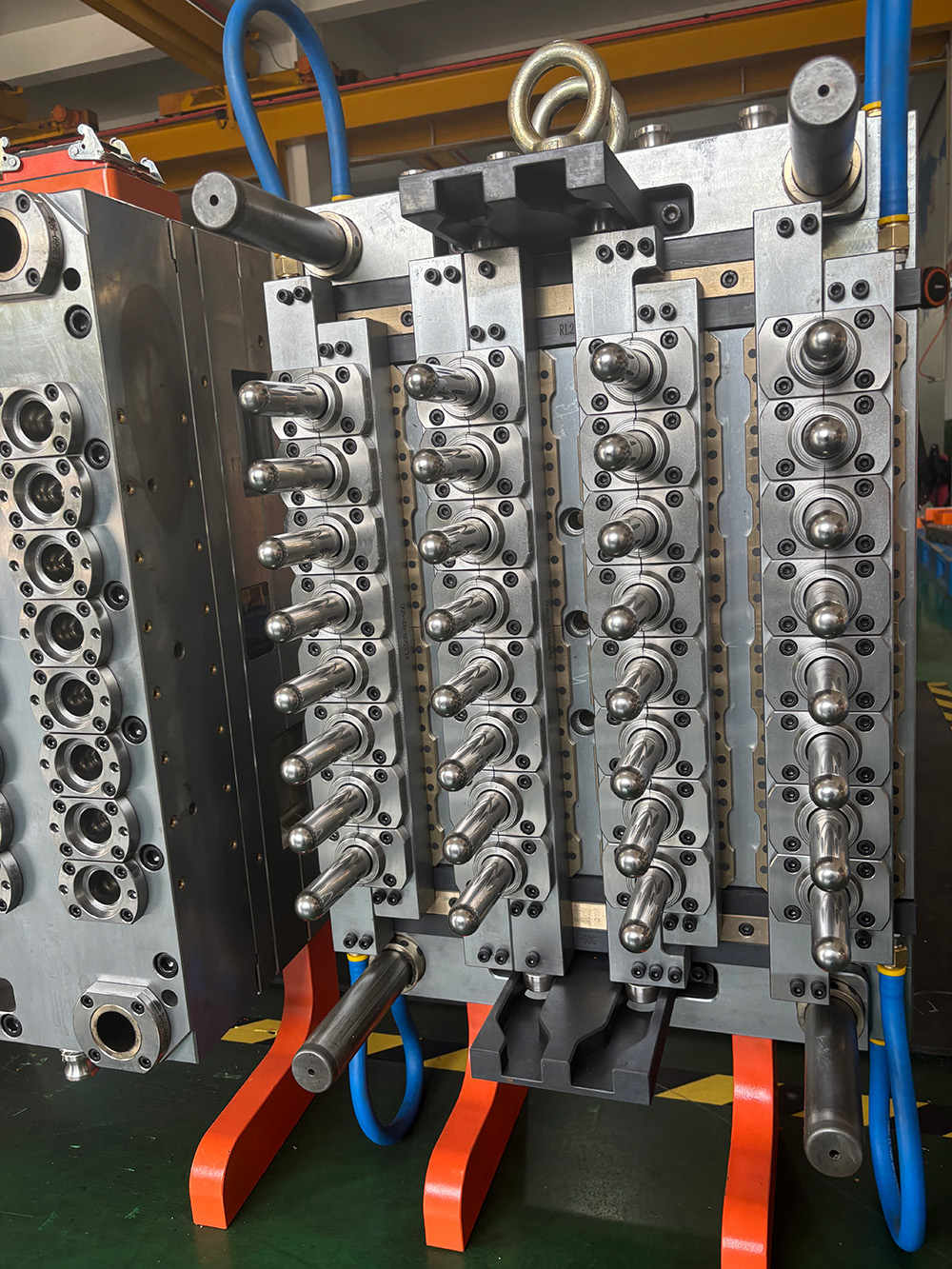
Part 1: Where Does Changeover Time Go?
A typical preform mold changeover involves five steps. Each step has hidden time-wasters.
| Step | Conventional Time | What Takes So Long |
|---|---|---|
| 1. Disconnect services | 10–15 min | Threaded cooling fittings, individual wire connections |
| 2. Remove old mold | 10–15 min | Bolts, alignment checks |
| 3. Install new mold | 15–25 min | Alignment, clamping, leveling |
| 4. Reconnect services | 10–15 min | Threading fittings, matching wires to diagram |
| 5. Test and validate | 15–30 min | Trial shots, parameter adjustment |
| Total | 60–100 min |
Meto‘s approach targets every step.
Part 2: Five Design Features That Cut Changeover Time
Feature 1: Push-to-Connect Cooling
Conventional: Threaded fittings. Operators turn each fitting 5–10 full rotations. With 8–16 cooling lines, this takes 10–15 minutes.
Meto: Push-to-connect couplings. Operator pushes the hose onto the fitting until it clicks. Removal requires pulling a collar. No tools. No threading.
Time saved: 8–12 minutes per changeover.
Feature 2: Self-Centering Locating Rings
Conventional: Standard locating rings require manual alignment. Operators use dial indicators to center the mold. This is slow and requires skill.
Meto: Tapered locating rings. When the mold is pushed against the platen, the taper automatically centers it. No dial indicators. No trial-and-error.
Time saved: 10–15 minutes per changeover.
Feature 3: Pre-Set Ejector Stroke
Conventional: Ejector pins must be adjusted every time. Operators run test shots, observe ejection, remove mold, adjust pins, reinstall, test again. This cycle repeats until ejection is correct.
Meto: Meto measures your machine‘s ejector stroke during mold design. The mold is built with fixed ejector pin heights that match your machine exactly. No adjustment during changeover.
Time saved: 10–15 minutes per changeover.
Feature 4: Single-Plug Hot Runner Connection
Conventional: Hot runner molds require connecting multiple wires — power, thermocouples, sometimes valve gate solenoids. Operators match wires to a diagram. Mistakes cause temperature problems.
Meto: All hot runner connections are consolidated into a single multi-pin plug. One push connects everything. No wiring diagram needed.
Time saved: 5–8 minutes per changeover.
Feature 5: Parameter Preset Sheet
Conventional: Operators dial in parameters from memory or a paper file. First test shots are often off, requiring multiple adjustments.
Meto: Every mold ships with a one-page setup sheet showing exact parameters used during trial molding at Meto‘s facility. Operators enter these numbers. First test shots are typically within specification.
Time saved: 10–20 minutes per changeover.
Part 3: The Cumulative Effect
| Step | Conventional | Meto Quick-Change | Time Saved |
|---|---|---|---|
| Disconnect services | 12 min | 3 min | 9 min |
| Remove old mold | 12 min | 5 min | 7 min |
| Install new mold | 20 min | 6 min | 14 min |
| Reconnect services | 12 min | 3 min | 9 min |
| Test and validate | 22 min | 8 min | 14 min |
| Total | 78 min | 25 min | 53 min (68% reduction) |
Meto guarantees a minimum 40% reduction. In practice, most customers achieve 50–70% faster changeovers.
Part 4: Real Customer Examples
Example 1: Daily Changeovers — Vietnam Water Bottler
| Detail | Information |
|---|---|
| Products | 0.33L, 0.5L, 1.0L bottles |
| Changeovers per week | 10 |
| Before Meto | 85 minutes per changeover |
| After Meto quick-change molds | 28 minutes |
| Annual time saved | (85-28) × 10 × 50 = 28,500 minutes = 475 hours |
| Annual production value regained | 400/hour) |
Example 2: Frequent Changeovers — Mexican Contract Molder
| Detail | Information |
|---|---|
| Products | 12 different preform weights |
| Changeovers per week | 18 |
| Before Meto | 55 minutes |
| After Meto quick-change molds (8 molds, standardized) | 18 minutes |
| Annual time saved | (55-18) × 18 × 50 = 33,300 minutes = 555 hours |
| Annual production value regained | 500/hour) |
Example 3: Occasional Changeovers — Nigerian Bottler
| Detail | Information |
|---|---|
| Products | 0.5L and 1.5L bottles |
| Changeovers per week | 2 |
| Before Meto | 110 minutes (limited experience) |
| After Meto quick-change molds | 32 minutes |
| Annual time saved | (110-32) × 2 × 50 = 7,800 minutes = 130 hours |
Even with only two changeovers per week, the customer regained 130 hours of production annually — more than three additional work weeks.
Part 5: Standardization Across Multiple Molds
The true power of quick-change design emerges when all your preform molds share the same interface.
Meto‘s standardized quick-change system includes:
| Component | Standard |
|---|---|
| Cooling fittings | Same push-to-connect type on all molds |
| Locating ring | Same taper diameter on all molds |
| Mold stack height | Identical for all molds (no clamp adjustment) |
| Ejector pin pattern | Same layout on all molds |
| Hot runner connector | Same multi-pin plug on all molds |
Result: Any Meto mold fits any machine prepared for the Meto standard. Operators do not need to learn different procedures for different molds.
Part 6: What Is Not Included in Quick-Change Design
Understanding what quick-change does not do is as important as understanding what it does.
Quick-change does NOT:
Automate mold changes (though it works well with automated change systems)
Eliminate the need for trained operators
Reduce the need for spare parts
Change the mold‘s core performance (cycle time, quality, life)
Quick-change DOES:
Reduce the physical effort of changeovers
Reduce the skill level required
Eliminate trial-and-error steps
Make changeover time predictable and repeatable
Part 7: Quick-Change for Existing Molds — Retrofitting
Meto can retrofit quick-change features to existing preform molds (including molds from other manufacturers).
Retrofit options:
| Feature | Retrofittable? | Typical Cost |
|---|---|---|
| Push-to-connect cooling fittings | Yes (if space permits) | $500–1,500 per mold |
| Tapered locating ring | Yes (requires machining platen side) | $1,000–2,000 |
| Parameter preset sheet | Yes (requires trial molding) | $500–1,000 |
| Single-plug hot runner | Possibly (depends on existing manifold) | $2,000–5,000 |
| Pre-set ejector | Difficult (requires mold disassembly) | $2,000–4,000 |
Best candidates for retrofit: Molds with at least 2 years of remaining life and good structural condition.
Contact Meto for a retrofit assessment. Send photos and specifications of your existing molds.
Part 8: Quick-Change vs. Automated Mold Change Systems
| Feature | Meto Quick-Change | Full Automated Change System |
|---|---|---|
| Investment | Low (5–10% of mold cost) | High ($50,000–200,000+) |
| Changeover time | 20–30 minutes (manual) | 2–5 minutes (automated) |
| Operator skill required | Moderate | Low (after automation setup) |
| Retrofits existing molds | Yes | Difficult |
| Best for | Plants with 2–15 changeovers/week | Plants with 20+ changeovers/week |
For most mid-sized bottle plants, Meto quick-change provides the best ROI — significant time savings without the high cost of full automation.
Part 9: Operator Training for Quick-Change Success
A quick-change mold is only as fast as the operator using it. Meto provides:
Training materials included with every quick-change mold:
Illustrated changeover poster (laminated, for machine-side mounting)
Step-by-step photo guide
Video walkthrough (accessible via QR code on mold)
On-site training during commissioning (optional)
Key training points:
| Step | Key Instruction |
|---|---|
| Cooling disconnect | Pull collar, do not pull hose |
| Locating ring engagement | Push mold firmly until taper seats |
| Ejector check | No adjustment needed — trust the preset |
| Hot runner connection | Listen for click on multi-pin plug |
| Startup | Enter numbers from setup sheet, do not guess |
Part 10: Calculating Your ROI
Use this simple formula to estimate your payback period for quick-change features.
Annual savings = (Current changeover time in hours – New changeover time in hours) × Changeovers per year × Production value per hour
Example:
| Factor | Value |
|---|---|
| Current changeover time | 1.5 hours (90 min) |
| New changeover time (Meto) | 0.75 hours (45 min — conservative estimate) |
| Time saved per changeover | 0.75 hours |
| Changeovers per year | 100 |
| Annual hours saved | 75 hours |
| Production value per hour | $500 |
| Annual savings | $37,500 |
Quick-change mold premium: Approximately 6,000 per mold
Payback period: 1–2 months
Even at conservative estimates, quick-change features pay for themselves within months — then continue saving money for the life of the mold.
Conclusion: Changeover Time Is a Design Choice
Conventional preform molds treat changeovers as an afterthought. Meto treats them as a design priority.
Push-to-connect cooling. Self-centering locating rings. Pre-set ejector stroke. Single-plug hot runner connections. Parameter preset sheets. These five features work together to reduce changeover time by 40% or more.
For factories that change molds frequently — daily, weekly, or even twice a week — the time savings translate directly into increased production and lower costs.
If you are ready to stop wasting hours on slow changeovers, talk to Meto.
Contact Meto today to discuss your changeover challenges. Request a free changeover time analysis or a quote for a quick-change preform mold.

Ruby
We can provide you with high-quality PET preform molds,cap molds,and blow molding machines.Looking forward to communicating and cooperating with you!
Helpline and Support
008613757660057